Asteroid City (2023)
I truly understood the controversy about this film, it's storytelling is both abstract and unforgiving. They way this film uses symbolism takes me to a headspace more akin to Weimar Cinema than the latest Hollywood trends. To me, it seems like Wes Anderson keeps pushing himself towards a modernist approach.
It felt like a play by Brecht, and the fact that the story is told as a play within a documentary tv show within a movie feels like an obvious decision to guide the audience to the headspace of those artists.
Technically is impecable, and fearing I'm being too indulgent, the few mistakes in continuity editing do feel intentional. Regardless of its symbolist nature it remains a happy colorful watch as any other of Anderson's previous films.
Just like in many of the modernist theatre plays the writing is structured with an “elephant in the room” approach. What is that elephant? Beats me. It's left intentionally ambiguous.
There are many symbols about the fears of future war and the repercussion of previous ones. Symbols about technology development and symbols about government and education. But to me these are all working towards the set-dressing of the “Asteroid City play”.
(I've seen few reviews following these threads, but they never feel conclusive enough to me.)
Now, onto my subjective read.
Remember, this blog is a collection of my personal notes, so forgive if my reviews seem scatterbrained.
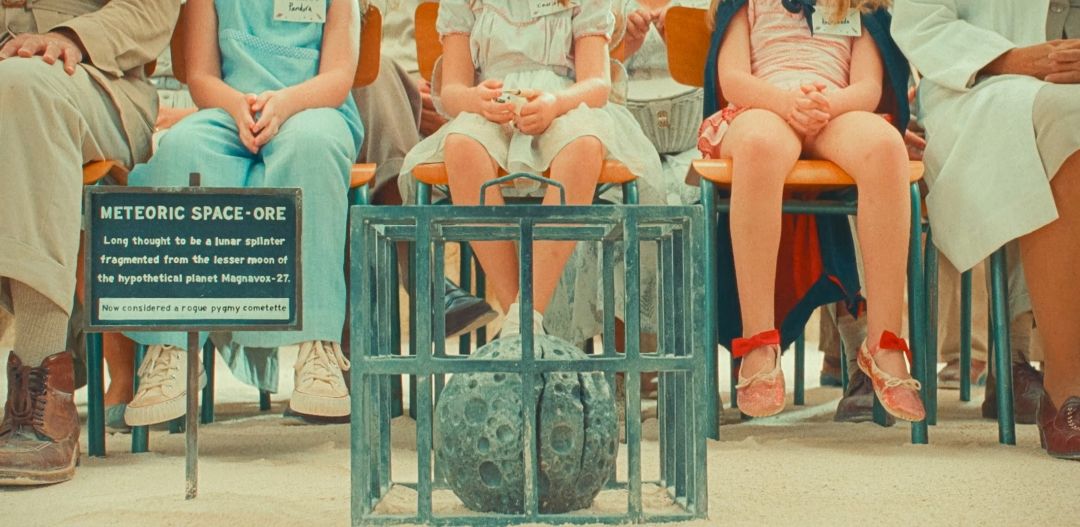
To me this movie is about accepting the “emotional elephants in the room”, facing them and accepting them as a fact of life.
This elephants could be about grieving, loneliness, dealing with uncomfortable family members, accepting our limitations, facing great expectations, running away from a violent partner, etc.
And it's presented with an special focus into parent-children relationships. All in a setting which enhances the feeling of being held captive by these elephants in the room, even stunned. (There are a couple of moments where the score turns into a stunning sharp sound which I love, btw)
We see Augie (the main character) struggling to tell their daughters Cassiopea, Andromeda and Pandora, about their mother passing; yes, one of the girls is named like the box that shouldn't be opened (more symbols about elephants in the room).
And even when he decides to tell them, the conflict does not stop as the movie hits us with the following fabulous dialog by Pandora:
Are we orphans?
Augie not only did not resolve the conflict by addressing the elephant but opened Pandora's box by doing so. From here on he's gonna keep dodging and putting a stoic hard face to the problem.
There's a great setup about time not being the solution but a band-aid to these elephants. Which is followed later in the film by another phenomenal line:
I'm sorry about your mother. I miss mine, too, and she died 46 years ago
The alien stuff is great. It works as a metaphor to all of the emotional elephants presented by each of the characters.It is even explicitly mentioned as “metaphor for something” in the film.
The key to understanding the alien is to wait until it's second appearance, when it returns the asteroid but “catalogued”. This symbolizes how the key step to speak about these emotional elephants is not only to address them, but to understand them.
Other elements of the movie such as the kids in a field trip, asking questions about the Alien to a teacher which confesses to be unprepared with the following line:
These are all reasonable questions; but, at this time, let's stick to Neptune — because I haven't had time to prepare any lesson plan on this subject we're talking about.
This group, kids and cowboys, dable into trying to understand it through a couple of lenses such as religion and nationalism. But end up living it, celebrating it. Completing the idea of addressing, understanding and living through these emotional elephants.
The whole discussions outside the play are generally speaking about how we're all putting on a play and acting through life. Using the actors as a way to visualize the character's inner workings and not the other way around.(which would explain why the movie ends within the play and not outside of it)
There's a group effort in the end, within an Actor's Studio (seemingly Lee's Strasberg New York's actor studio) that plays into several inner dialogues which puts special focus into Augie's principal elephant:
He needs to address, understand and accept his grief for his late wife.
Not gonna spoil that scene, but it's wonderful.
The movie finalizes the idea with the actors acknowledging that there is no correct way address this emotional pits and tragic events during our life. And adds not only that they happen but they need to happen in order to grow.
You can't wake up if you don't fall asleep!
Here's where the setting works better for me. Once they resolve their emotional elephants, the quarantine is quickly lifted, leaving the characters free to continue with their lives; no longer held captive by them.
17/10/23, SDS 4K HDR Blu-ray (No Bonus)